
2026
| NZASE | Phase 4 (Year 9) resources DRAFT NZASE Regional Branches have developed these sample Phase 4 (Year 9) units as flexible starting points for planning. Each unit covers approximately four weeks and can be adapted to suit your local context, students’ needs and preferred teaching approaches. As the units are based on the draft Science Curriculum, we are looking to update and align with the finalised curriculum. | Body Systems | Body systems Matter | Ecosystems, the periodic table, matter and Earth and Space Papatūānuku & Ranginui | What on Earth? – Earth systems |
| MOE | Phase 4 (Year 9) Science Learning Kit MoE has produced learning kits for Year 9 Science; including annual plans, unit plans, and associated lesson plans. | Available here. |
| Term 1: Term 1 2026 PLD | Workshops | S1.1, S1.2, S1.3, and S1.4 Explore four key science standards with guidance from Linda Haycock in this practical webinar series. Covering S1.1 through to S1.4, these presentations unpack how students can engage with local issues, investigate using a range of scientific approaches, understand how science ideas develop in context, and critically evaluate science-related claims. Each resource has clear explanations, classroom-ready insights and helpful examples to bring the standards to life. | All webinar recordings, presentation slides, and supporting resources are available in this Google Drive. S1.1 Demonstrate understanding of a science-informed response to a local issue S1.2 Demonstrate understanding of the use of a range of scientific investigative approaches in a context S1.3 Describe features of science that have contributed to the development of a science idea in a local context S1.4 Demonstrate understanding of science-related claims in communicated information |
Previous PLD resources
2025
Free NEX Funded Science Alive Workshops: Ready for something a bit different? Science Alive has been inspiring New Zealand’s next generation in science and technology since 1991 and produced a range of resources available here.
| Term 1: Main Focus: Unpacking Moderation, Writing and Critiquing Assessment Tasks. | View resources | Information flier |
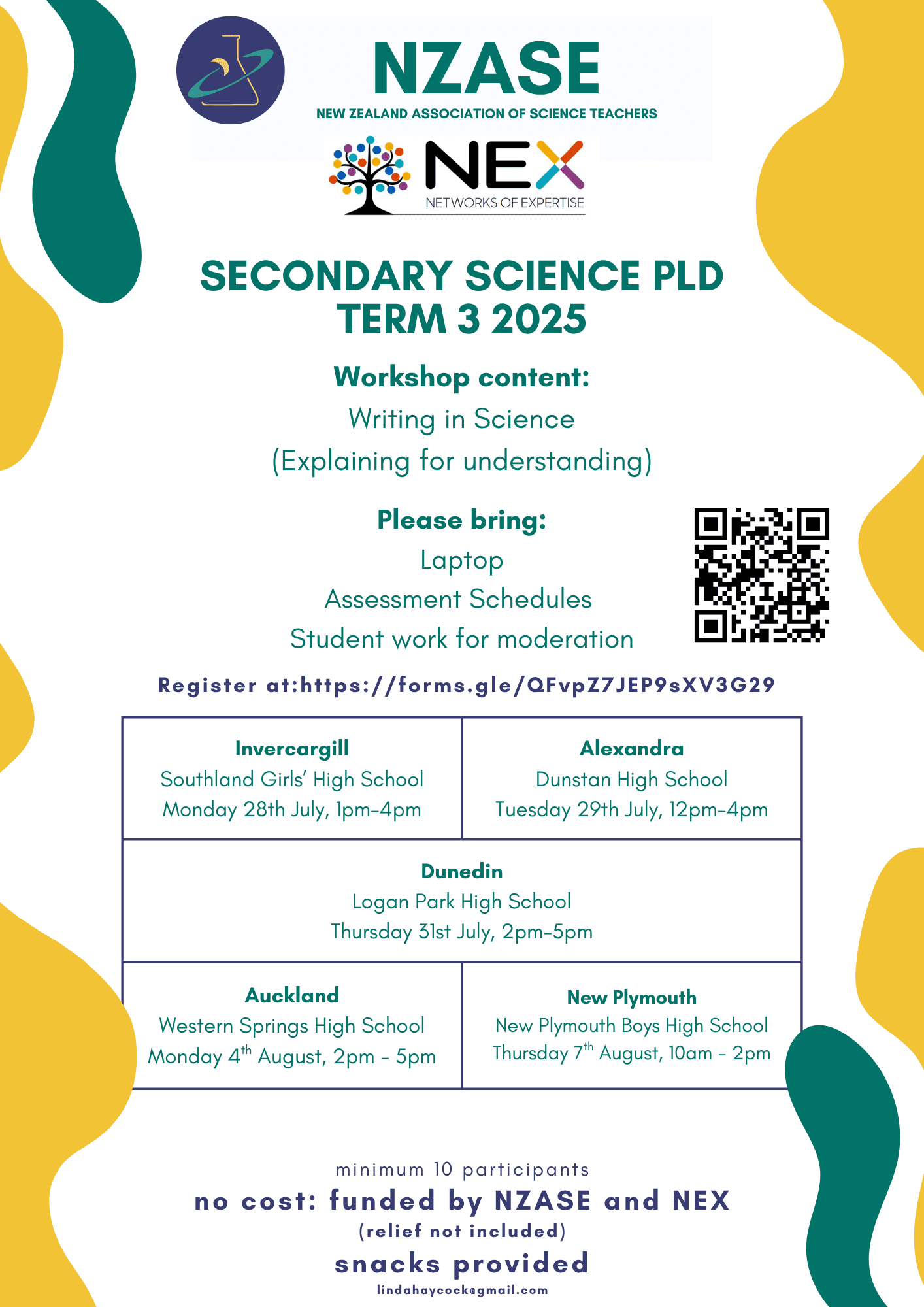
| Term 2: Main Focus: Numeracy + Context = Science , Writing Assessment Schedules and Moderating Student Work. Term 3: Main Focus: Literacy in Science: Explaining for understanding | Workshop poster | View resources |
| Term 3: Writing in Science | Workshop poster | View resources |
| Term 4: Main Focus: Science education: moving forward Looking back at 2025 science education, L1 standards, inclusion of literacy and numeracy, then looking forward to the next steps for 2026. | View resources |
2024
| Term 1: PLD involved weekly support for L1 NCEA Science. Each presentation was recorded and, together with the PowerPoint, a written summary of the discussion and some shared resources. | Available here |
| Term 2: The PowerPoint, shared resources and discussion summary from the Term 2 clusters | Available here |
| Term 3: Overview | Available here |
| Term 4: Overview | Available here |
2023
| L1 Unit Plans | In mid-November 2023, NZASE brought together a group of 12 experienced teachers, four from pilot schools, to create these L1 units. They are intended to show teachers what units might look like for a L1 course assessed with the NCEA Science standards. We hope you find these units helpful. Please make a copy of the folder or files, and then you will find those copies in your own computer’s Google Drive (look for My Drive on the left side of your screen). |
| Pilot school resources | Watch the December 1 2023 panel discussion with some pilot schools on the new L1 Nature of Science standards. |
2022
In 2022, NZASE organised four webinars, each focussing on one of the L1 Science standards. In these, teachers from four pilot schools were interviewed about how they approached each standard, the teaching and the assessment. View these webinars below.