Weaving Mātauranga Māori into the classroom | Kaupapa Māori educator Koha Kahui-McConnell

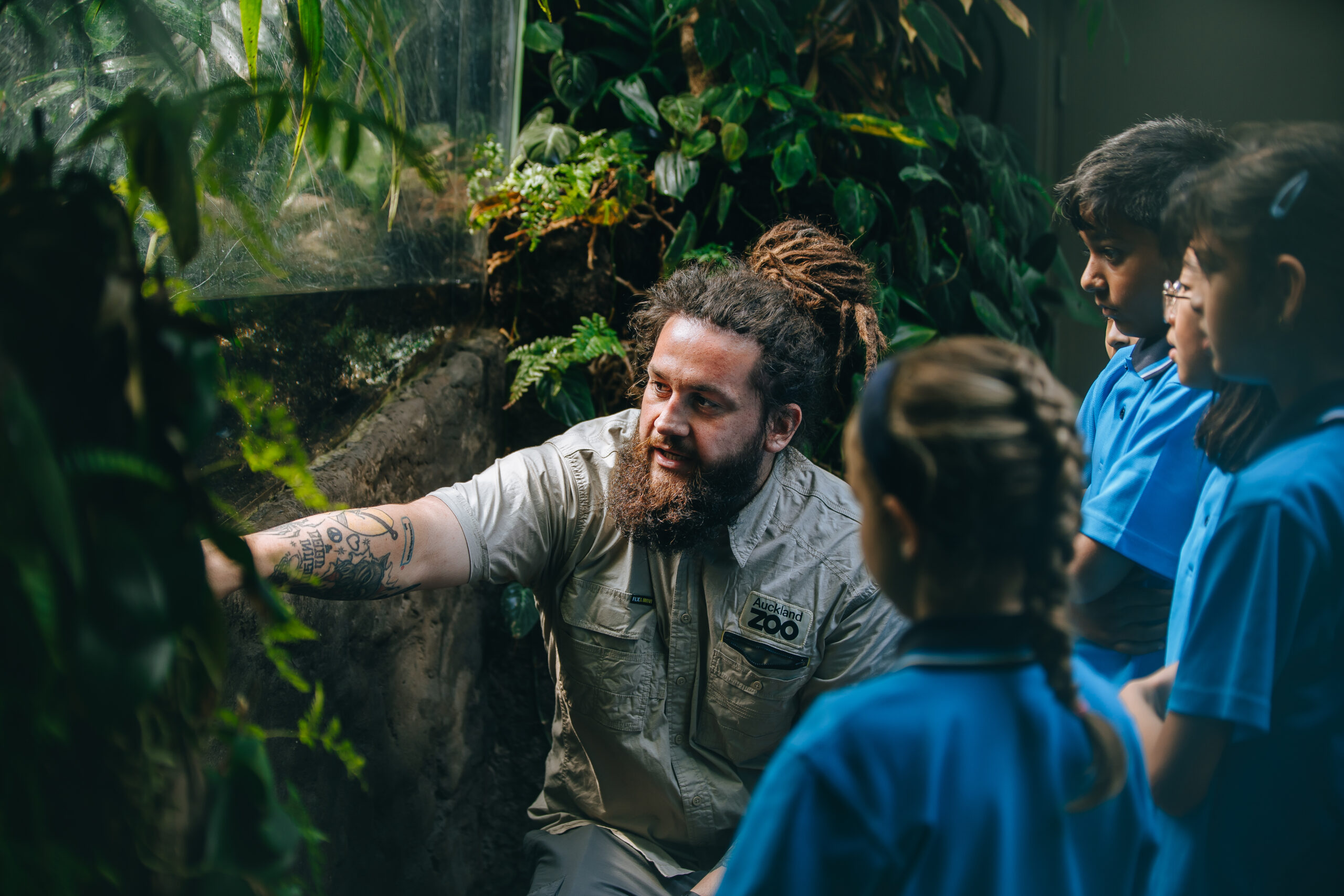
At Auckland Zoo, Conservation Learning Facilitator and kaupapa Māori educator Koha Kahui-McConnell supports students to explore scientific concepts through mātauranga Māori and Western science. In this profile, he shares his philosophy about helping rangatahi understand that everything has a whakapapa and protecting the natural world begins with recognising our place within it.

He uri tēnei nō Ngāti Porou me Ngāti Maniapoto anō hoki, kei tāmaki Makaurau e noho ana ahau. Ko Koha Kahui-McConnell tāku ingoa. He kaimahi ahau ki te rōpū akoranga whāomoomo nō te Whare Kararehe ō Tāmaki Makaurau.

I am a descendant of Ngāti Porou and Ngāti Maniapoto, and I live in Auckland. My name is Koha Kahui-McConnell. I am a staff member in the marine studies group at the Auckland Zoo. 

Background

I am the beneficiary of an environmentalist mother and an outdoorsy ‘give it a go’ father. I spent most of my formative years in the far north every summer break camping for between two to four weeks in a bay that had no reception, no hot water and no power, but an abundance of green space, a healthy and functioning marine ecosystems and enough space where every day could feel like an adventure. Through my time growing up on this beach, I became fascinated with the ocean and its inhabitants, crawling through rock pools at low tide to see what life was already present and what life had been temporarily trapped until the next high tide.

As I got older, I became increasingly aware of how our marine environments were being mistreated and misused. My mum wanted to foster this curiosity, so she made a concerted effort to put me next to as many marine scientists as possible, helping to grow my passion for conservation and giving me an idea of how I could make conservation a full-time job. From this passion came my previous work in community marine protection advocacy with Experiencing Marine Reserves and waste diversion through Para Kore Ki Tāmaki. Within both roles, it was my job to help people understand how to better their relationships with the world around them, not so they could take, but so that they had a holistic understanding of the phrase ‘ki uta, ki tai‘/’from the mountains to the sea’. It was in these roles that I truly discovered my passion for teaching as I saw students from a wide variety of backgrounds and year levels understand the incredible world just below the surface of the water and how we can protect it by being mindful of what we use and throw away. While working at Auckland Zoo, I’m fortunate to get to see students go through a ‘wow’ moment almost every day, understanding that the incredible animals that we are fortunate to care for are just that, incredible and deserve to be protected.

Using mātauranga Māori to explore concepts such as ecosystems, evolution, and the connections in nature

Within science, there is a concept known as observational science. To me, observational science, while not unique to Māori, is something that indigenous cultures around the world have been doing for thousands of years. Through using observational science, cultures have grown understandings of how the stars and the seasons are connected, the migratory patterns of birds that would give people an idea if land was near or if there was a storm on the way, and the blooming of specific flowers that told them the best time to plant crops for the seasons to come. I think it is an important skill that has been minimised over the generations within science fields, and especially within science education. These observations are not something that were divined overnight but came through generations of people working with the land and the sea. Within te ao māori specifically, there are concepts of interconnectedness and interdependence of species that science has only come to accept in the last 100 years. Additionally, within the maramataka, there is tikanga that is focused on the balance between give and take, which can then be woven into what we now call regenerative conservation.

The importance of learning Indigenous knowledge and Western science

Yes [it is important], but not only in the context of having a wider range of understanding the similarities and differences between the two knowledge systems but also as a method of codifying those same pieces of observational science that I spoke of earlier, and as a way to empirically justify to local, central and international governments. The best example that I can give of this was the mussel project that was undertaken by Ngāti Whātua Ki Ōrākei, which wove together empirical evidence from the University of Auckland’s marine biology department and kaumatua from Ngāti Whātua to regenerate Okahu Bay, by releasing 13 tonnes of green-lipped mussels into the bay to filter out the heavy metals and pollutants from the bay. This project used Western scientific methods of charting to evaluate the success of the project but relied heavily on the local knowledge that the kaumatua had of the ocean’s currents and the migratory movements of seabirds to understand the best places to drop the mussels in the project’s infancy.

Using stories to help students understand scientific ideas

Throughout all of human history, across all cultures, stories have been used to inform the way that we understand and quantify the world around us. They are effective ways to transmit and understand broad concepts like where humans came from, how we should interact with the world around us or to warn of dangerous places or the dangers of breaking tradition. Within a scientific context, pūrākau gives the listener a broad range of views on how our position within the world can have positive or negative impacts. I can personally attest that my introduction to concepts like conservation, regeneration and holistic interactions between species was through pūrākau. They provided a framework for wonder and exploration that fed into my desire to understand the world around me better.

Student reactions to learning about classification through whakapapa

I think there are two parts to the surprise that I see in students: the first is representation. Working at the Zoo I’ve come to appreciate what representation means and how this can have a positive impact on students, seeing someone that looks like them, speaks the same as them and is in not only a public facing role, but is also someone who is talking to them about a concept that they have learnt about from an early age in a brand new context can be surprising to a lot of Māori students. The second thing that I think is surprising is that whakapapa does not have to be specific to people; it can be viewed as a concept that then covers animals and the world around us, too, just like how everything has mauri, everything has a whakapapa. Everything and everyone comes from somewhere, and I think the surprise comes from being able to take a simple concept and make it larger.

Using mātauranga Māori in science lessons

The first port of call whenever adding anything te ao Māori-related to any kind of content is: why? Why are you adding these concepts to your lessons? Is it just because you could, or are you trying to find a different context to explain your content through?  Once you have figured out your why, I think that it is important to be considerate of the framing with which you present matauranga Māori to students. For far too long, pūrākau have been classified as myths or legends, rather than palatable stories through which all too real experiences are described and examined, or that these important stories serve to explain viewpoints or observations of how the world works. Specific to whakapapa, because it is an easy concept to understand, it’s something that can be more readily adapted to audiences that are both māori and non-māori. I therefore think that using whakapapa as a framing mechanism through which you can explain either biomes, nutritional needs or ever speciation is an excellent place to start.

Practical ways to introduce whakapapa into the classroom

A way to introduce the overarching concept of whakapapa, which is interconnectivity, is through making a web using atua Māori as central connecting pillars, from which everything else connects back to. From all of these atua come the plants and animals that live within their realms (i.e. Tangaroa – connected to Tangaroa are fish, kelp, crustaceans etc), then you can interconnect all of these different animals to what they eat, what eats them, where they live and what other things they rely on to survive i.e. birds rely on trees to make their nests. I think this provides a simple and effective visual understanding of how the world around us is so interconnected. Another way to build on the prior knowledge that students may have about whakapapa in a more literal sense is to give them the ability to discover where they come from, using pepeha or an approximation of it. Through pepeha, Māori have an intrinsic connection to land, where maunga are seen as the eldest kaumatua that can be seen. Through this generational understanding of place comes mana, and mana is something that everyone has. Giving students the opportunity to understand what mana means as a starting point is both empowering and gives them a real connection to, if not Aotearoa, then where their parents and grandparents are from.

Ngā kupu

Atua – ancestor with continuing influence, god, demon, supernatural being, deity, ghost, object of superstitious regard, strange being
Maramataka – lunar calendar
Pepeha – introduction sharing connections to ancestors (whakapapa), land, and landmarks (mountains, rivers, marae)
Tangaroa – Atua of the sea and fish
Te Whare Kararehe o Tāmaki Makaurau – Auckland Zoo
Whare kararehe (house of animals) or whakaaturanga kararehe (animal exhibition) – Zoo
Whakapapa – genealogy, lineage, descent

Source: Māori Dictionary

NZASE extends its sincere thanks to Koha Kahui-McConnell for generously sharing his time, experiences and kaupapa for this profile.