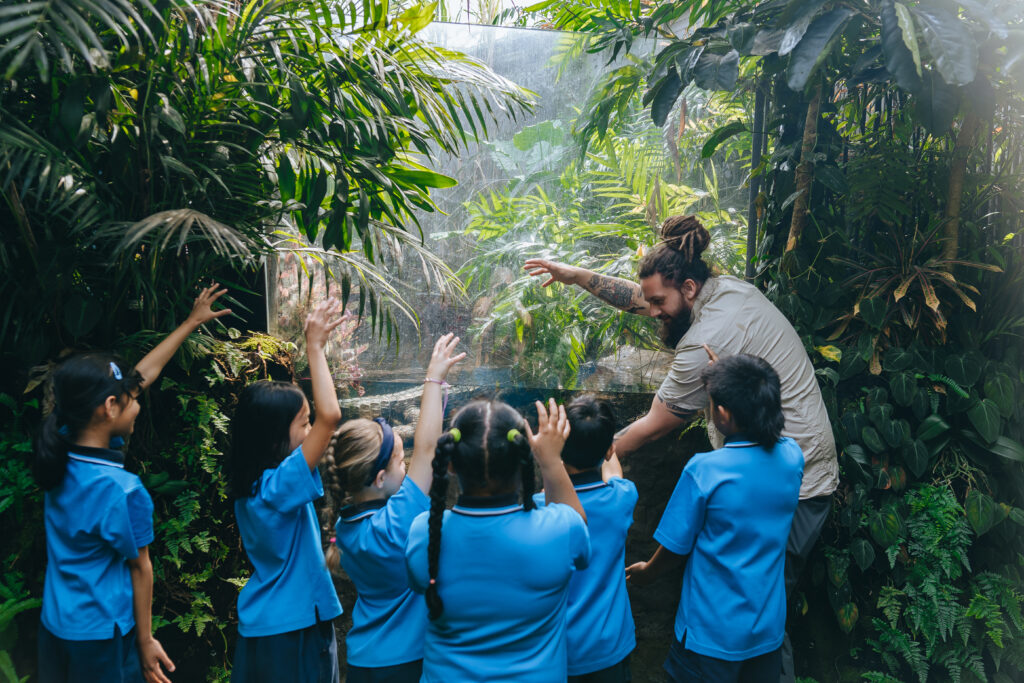
Auckland Zoo – Te Whare Kararehe ō Tāmaki Makaurau offers an on-site conservation learning visit focused on whakapapa and how living things are classified in te ao Māori. Guided tours of native habitats help students discover the origins of incredible kararehe/animals living in Aotearoa and discover how observing te taiao/the natural world shapes indigenous knowledge, revealing connections among all living things through whakapapa. Thanks to James Beattie, Duty Operations Manager – Conservation Learning, for his overview of this Year 0-8 EOTC opportunity.
What will students see, do or explore during a visit?
At the start of the session, the students will talk about atua and the different spaces they preside over, starting with Papatūānuku and Ranginui and their children, such as Tane Māhuta, Tangaroa, and Tawhirimatea. From there, the students will walk through two separate habitats with different animals, starting with Te Wao Nui a Tane – New Zealand Forest Habitat. Here, they will see a number of native and endemic birds and then talk about their relationship to Tane Māhuta and how they whakapapa to Tane. They will then move to another habitat (either Te Whenua Waotu/High Country or Te Repo/The Wetlands), where they will talk about how other animals whakapapa to other atua. This gives students a broad understanding that there are many atua within te ao Māori, and they occupy different spaces and have different descendants, each with its own whakapapa.
Can visits be tailored for different years?
Absolutely, the way that this is tailored is based on the students’ depth of understanding of Atua and what they protect or preside over. For Year 7 – 8 students, they will mostly have a basic understanding of some of the atua, it is about giving them an understanding that different animals can whakapapa to different atua based on where they are from. For example, if you are from a coastal iwi or hāpū, you might think that tuatara whakapapa to Tangaroa, as tuatara and mako (sharks) are brothers; however, if you are from a more inland iwi or hāpū, then you might think that tuatara whakapapa to Ruaumoko because the ridges on their backs resemble the mountain ranges. As the students get older, the content becomes more focused on knowledge that the students might have of their own local area rather than it being prescriptive.
Programme highlights
Typically, the most impactful part of this programme is students seeing the animals in a new light and understanding that, just as we have a history behind us, so too do these amazing animals. For teachers, a lot of the time the most impactful thing is that we are reinforcing things that they may have already told their students regarding te ao māori, whether that be that there are different atua that occupy different spaces or the simple fact that these animals are taonga (treasures), none the less, having that information be reinforced is typically the most impactful thing for teachers.
New Zealand Science curriculum connections
Science – Nature of Science
- Understanding about science L1-2: Appreciate that scientists ask questions about our world that lead to investigations and that open-mindedness is important because there may be more than one explanation.
- Understanding about Science, Investigating in Science, Communicating in Science.
Science – Living World
- Ecology – L1-2: Recognise that living things are suited to their particular habitat.
- Evolution L1-2: Recognise that there are lots of different living things in the world and that they can be grouped in different ways.
- Evolution L3: Begin to group plants, animals and other living things into science-based classifications.
- Life Processes L1-2: Recognise that all living things have certain requirements so they can stay alive.
- Life Processes L3: Recognise that there are life processes common to all living things and that these occur in different ways.
Additional links to Social Science, History, Geography and Learning Languages.
Details
45-minute duration. Bookable from Monday to Friday, starting from 9:30am
Minimum adult-to-student supervision ratio: ECE 1:3 | Years 0–6 1:6 | Years 7–10 1:15 | Years 11–13 1:30
Cost of sessions for NZ educational institutions: School students: Years 0 – 13, $10 per student; 1 free adult per 6 students; 1:1 teacher aids are free. Additional adults outside the ratio are $19 per adult. Double sessions are $20 per student.
Pre-visits
Complimentary pre-visits are available for educators/teachers. Contact the team.
Contact details
More questions? There’s an excellent FAQ page for education visit queries.
Auckland Zoo – Whakapapa session website
Or contact the team by email or (09) 360 3817.