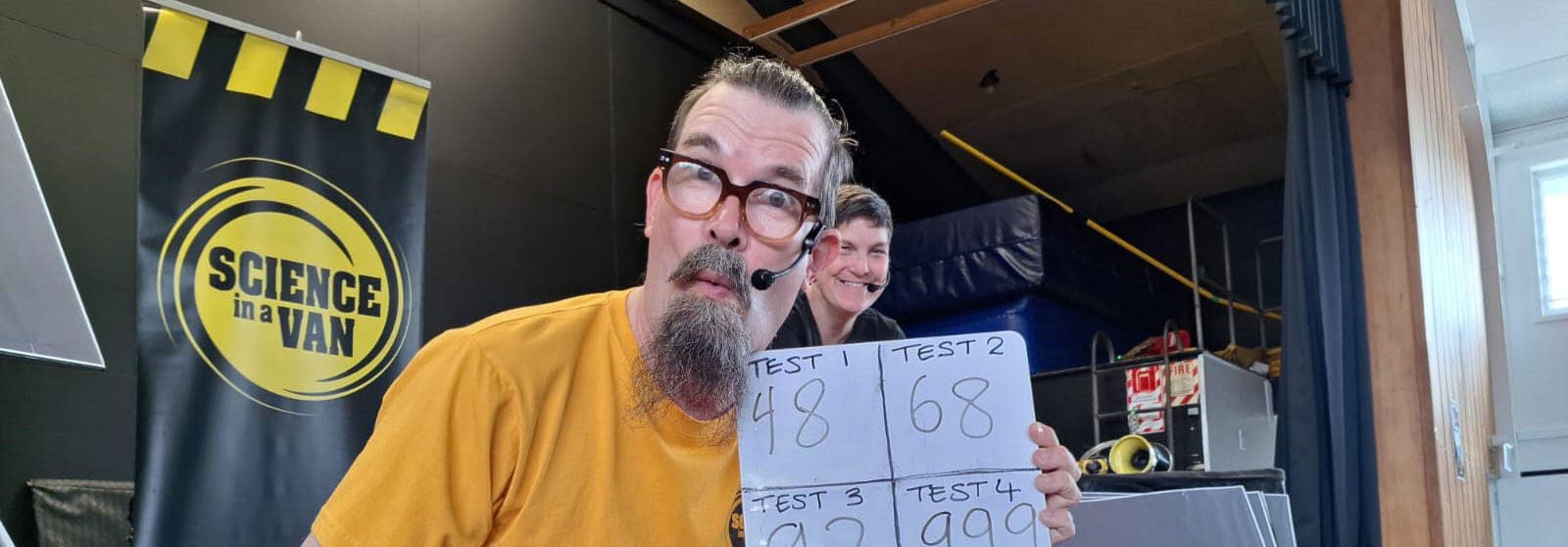
Science lives in the everyday — yet sometimes it gets delivered by folks in yellow t-shirts, knee-high socks and big grins who emerge from a van crammed with unexpected objects. Since 2011, the founders of Science in a Van, Emily and Alan Worman, have made over 1,500 visits to schools, early childhood centres, museums, libraries and community groups across Aotearoa. Now, as they celebrate their 15th anniversary, the pair sit down with science communicator Ceana Priest to reflect on their journey from the Science Museum in London to classrooms across New Zealand — and how curiosity and flying rubber chickens can spark a lifelong love of science.
Emily and Alan Worman first crossed paths at the Science Museum in London — an almost ‘eyes-across-the-smoko-room’ kind of moment, they say. Housed in one of England’s oldest and most iconic scientific institutions, their workplace was a hub of creativity, and, as Emily describes it, “a bit like the nerdy hospitality scene. It was such a tight group of people — we had the best time.”
Emily had arrived in London on her OE after growing up in Māngere East, completing a degree in politics before following in her family’s footsteps to become a teacher. But in London, her friends successfully encouraged her to swap teaching for an ‘explainer’ position at the Science Museum, where she went on to develop children’s activities and sleepovers, and to organise late-night museum events featuring everything from pedal-powered concerts to Japanese drummers.
Although Alan grew up closer to the Science Museum in East London, his journey there was far from direct. He moved from studying printmaking and painting to working in security, then into sales at a print company — a detour that prompted him to rethink his life choices. Eventually, he landed at the Science Museum, touring schools across England and Ireland with historic objects — and even driving a replica of Stephenson’s Rocket through Hyde Park. Despite his varied careers, it made sense that he became a science educator. “I’ve always been interested in stuff, doing stuff and communicating. At the Science Museum, it was all about learning and communicating. And my art was and is very much like that as well.”

The pair lived in Elephant and Castle in central London, just south of the Thames, with great jobs and busy social lives — but they realised that if there was more to explore in life, it wasn’t in their hectic London routine. So, they gave up everything, sold what they had, walked across Spain, volunteered with an education project in India and arrived in New Zealand at the end of 2010. Shortly afterwards, teacher friends, aware of their educator backgrounds, asked them to run a few in-school science shows.
“We’re like, are you serious?” Emily recalls. But after thinking about it, they both realised it might actually be a thing and wrote The Wonderful World of Bubbles.
“We thought we were just going to travel around New Zealand and do a few bubble shows to pay for our pies. But it just took off pretty much immediately.”
It was 2011, and this promising start of Science in a Van perfectly aligned with a government push to use everyday objects in science, which was exactly what their show was about. “In some ways, the timing was just right, and we were just really, really lucky, and schools loved what we did, and there was a gap in the market,” Emily says.
Now more than an estimated 2,500 shows later – often doing multiple shows at each organisation – and after surviving COVID-19 lockdowns, Emily says simplicity is key to their shows. “Because, when you do a science experiment, like the vinegar and baking soda…there’s a million things you can talk about…change in temperature…how it fizzes up…colours. But you don’t need to talk about all those things all at once. Like, you just can’t. It’s impossible.”


Despite neither of them being university scientists, she says they follow scientific processes. “I think it’s quite good for us to tell people we’re not what you think a scientist is…you know, we’re all scientists. We don’t pretend we know everything because we don’t, but it’s having that confidence to be okay with that. I think that really helps with any subject, but especially science.”
It was at the Science Museum that Emily realised she didn’t need to be an expert. “I didn’t have a science background, but I learnt that you can just ask questions. You don’t have to be completely right, but you must think. Now I’m not afraid to not know. I’m a more genuine learner now because I’m like: ‘let’s just find out’.”
Humour plays a big part in their shows, quickly breaking down barriers and helping students “accidentally” learn. The best teachers are those who have good relationships with their students, Emily says, and for their 45-minute shows, she says you’ve got to build a relationship fast. “So, if you can share a joke…you share something in common. The teachers love it too — we have jokes just for them.”
It helps that Alan dresses like a five-year-old. “I think our whole look and humour — I wear black shorts, yellow knee-length socks and the yellow t-shirt — that’s not how a scientist is supposed to look,” he says. “You know, where’s my white lab coat, where’s my safety goggles? I think it just kind of adds a bit about who we are, breaks some of the tension…and it shows that we’re kind of there for fun. I think people hook into that, and once you’re having fun, you accidentally learn.”

Watching science light up kids’ eyes rewards them both. Having performed thousands of shows, they know when to watch for reactions: “And it’s absolutely amazing,” Alan says. “When Emily does the vinegar and baking soda…you don’t get tired of seeing 200 odd kids all scream and want to stand up and see the mess on the floor. You’re like, yeah, this is landing, and this is getting them.” Or sometimes during a quiet moment in the show: “…you say or do something, and one kid just goes, ‘What? What the hell?’” Alan says that everyone laughs but knows they are all thinking the same thing.
“Sometimes your breath is taken away,” Emily says of the students’ responses. “And they don’t even know they’re doing it. It’s awesome…they’re not in control of it.”
Students will often come up after the show to ask questions, and sometimes a teacher follows, saying the student hasn’t shown much interest in science. “It’s nice to know that you’re connecting all these different people,” Alan says. But it’s not about evangelising the kids, he adds: “Like, if Billy wants to be a little pop star, well, good luck to them. But if we get them to realise that science is a tool they can use to understand that journey, great. Maybe they might write a pop song about science.”
Being an outside provider has many benefits, Emily says, almost helping students reinvent themselves within the learning process. “I think because we’re a novelty, and we have no idea what these kids are like. And I think kids can pick up on that. Kids do get a bit of a label sometimes — ‘Billy always runs out of the hall’ — well, we don’t know that. And I think they can pick up on it and be who they want to be. And we’re not going to suddenly jump on them, or we’re not going to not expect them to do something. We’re like, oh, we’re all going to do this together, and we’re going to have a great time. I think it’s a really positive thing for outside people to come in.”
Often, a show will wander into a tangent, following a kid’s curiosity — the duo happily admit to enjoying a little “neuro-spice” in their shows — Alan’s dyslexia and Emily’s ADHD are both formally diagnosed.
After 15 years of Science in a Van, what keeps them engaged in science? For Alan, it’s a lifelong curiosity and hands-on exploration. From a young age, he’s needed to get closer to things — the more dangerous, the closer — to pick them up, use them, and see what happens. “I think that is basically what science is,” he says. “What happens if I do this…make a prediction, try it out, test it, see what happens and then from those observations go back to the beginning and start doing it again. I just wake up each morning wanting more of that.”

For Emily, her arrival into science feels a little by accident. She’d never considered science as a career path, having dropped science in Year 11. “I’m not ashamed about that,” she admits. “My teachers were boring. But I’m passionate about it now because our job is so cool. We get to work together. We know so many great teachers. I don’t always get it right, but I understand the process, and I feel like science has a place for me. Until I started working at the Science Museum in London, there’s no way I would’ve even considered that. I wouldn’t even have thought that was a thing. It’s just a happy surprise.”
Ultimately, Alan says science is a tool for understanding the world, and for him, the best part is sharing it with others. As part of their show, they explain energy transfer by placing a small ball on top of a big ball and dropping them together. “And it’s great that when you go out to the playground [afterwards] to get a coffee at playtime, there are balls flying all over the place and general chaos. And you’re like, yeah, you’re doing science, people.”
About the show
Science made simple and surprising: A typical 45-minute show for 100–250 students uses everyday objects and comedy to explain physics, chemistry and the nature of science.
That might mean:
● Launching rubber chickens on water rockets to explore the laws of motion.
● Filling bubbles with helium to show that gases have weight.
● Helping students realise that materials are all around them, including their very own fingernails, which grow due to the materials (food) they put in their bodies!
Keen for the team to visit you? Register your area by contacting Emily or make a booking online. Show costs begin at $700 + GST per show. This covers up to 100 students. Their brand new show, “Full Force!”, celebrates 15 years of Science in a Van!
Emily Worman | [email protected] | 022 682 3009 | Website
Ngā kupu
koropupū Tūingoa, Tūmahi Poro, Tūāhua: fizz, fizzy
matapae ~tia Tūingoa, Tūmahi Whiti, Tūāhua: predict, prediction
mirumiru Tūingoa: bubble
rongo tāwara Tūingoa: sense of taste
rongo whakapā Tūingoa: sense of touch
Full Māori to English wordlist for The Wonderful World of Bubbles available here.