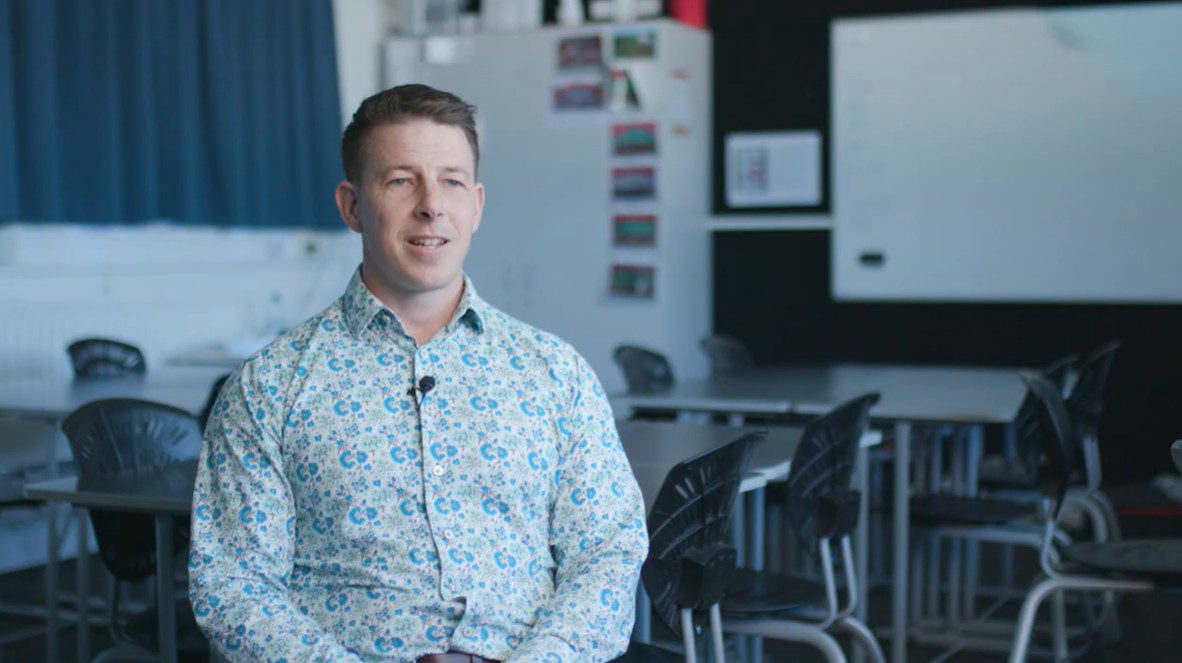
Teacher Q&A | Head of Science, Aorere College | Dr Aidan Kiely

From hunting fruit flies in university labs to leading science at Aorere College, Dr Aidan Kiely’s journey into teaching has been shaped by a belief that science should feel relevant to every student. In this Q&A, Aidan reflects on hands-on learning, stream restoration projects, mātauranga Māori, and the importance of creating science classrooms where all young people can see themselves thriving.

What was your journey into teaching science? 

    I’ve been a science teacher at Aorere College, Tāmaki Makaurau ki te Tonga, since 2016. I entered teaching through Ako Mātātupu Teach First NZ, which has the ambition of ensuring that all tamariki have the opportunity to flourish. In that time, I’ve moved from trainee teacher to Head of Science at Aorere College.

    I was always a curious kid, and I guess lucky to have that nurtured all along my schooling journey. I grew up in Oranga and Onehunga, Auckland. Mum was always happy to take us to the library, and Dad is an architect, but also studied psychology, so we had lots of support with our questions. I recall doing things like science badges at primary school and really enjoying the step into the labs at high school, with the science fair and the various investigations we got to do.

    I have just always enjoyed knowing stuff about how things work! I got to the end of high school, not sure what to do at university – I picked biotechnology as it was a mix of biology with a bit of engineering. I followed opportunity after that: a summer studentship into an honours project, an honours project into a doctorate and a doctorate into a post-doctorate, with each going a little bit further into the molecular mechanisms of smell and taste in fruit flies and mosquitoes. Eventually, though, I ran out of steam doing that. I had really enjoyed the science outreach work I was doing overseas, and I also really enjoyed coaching sports, so I thought teaching might be a great shift. So far, it has been that!

    What does science in the classroom look like on a good day?  

      A great day in class is seeing everyone engaged in a great hands-on experience with rich conversations flowing around the room. Students are engaged because they are being scientists: investigating something that they find interesting and relevant. Somewhere a student has just figured something out for themselves, leaned over and whispered it, conspiratorially, to someone else. Three others are standing at the whiteboard, discussing their findings. Most of the work from the teacher has been done in the preparation and you are freed up to prompt and probe for the student’s thinking.

      How do you engage students who might not be interested in science?

        Part of the answer to engaging students is understanding why the student isn’t that interested in science. Has it been boring before? Does it make them feel dumb? Do they think it is irrelevant to where they are heading after school? Do they not like school at all? Knowing a bit about the student lets you find small hooks that can bring them in. The world is full of interesting phenomena you can harness to capture some momentary sense of wonder, and every kid can observe something. From there it’s about making learning enjoyable, practical, making connections to the wider world and helping them to recognise that even if they don’t see it: they are the descendants of incredibly successful scientists!

        Are there local places, people or issues you use to help connect science to students’ lives?

          We are in the ninth year of a stream restoration project on the local Waokauri Stream (above images). This stream marks one end of a portage route used by Māori across the narrowest part of Auckland and is home to many native fish species. Each year, our Year 9 cohort visits the stream to collect data, uses the data to plan actions and then returns to the stream to carry out their action. It helps us to make an early start on showing the students that science isn’t just something you know, it is something that you do. It also helps us connect with the local kindergarten and other members of our Sustainable Schools cluster, which provides leadership and networking opportunities for our students. I have been fortunate to collaborate with scientists from Plant and Food Research, AUT’s Marine Biology School, WilderLab and Auckland Council on various projects with our students. These experts have their own ideas about how to make science meaningful, and leaning on their expertise and willingness to share can be hugely beneficial.

          Article: Education Gazette | Embracing eDNA technology to restore local stream [March, 2023]

          How do you incorporate mātauranga Māori into your teaching?

            Our kura is situated within the rohe of Te Waiohua (Te Ākitai, Te Ahiwaru and Ngāti Te Ata). It rests on the slopes Ngā Kapua Kohuora, one of Ngā Tapuwae o Mataoho, the sacred footsteps of the volcano deity, Mataoho. These volcanoes are visible across the region and the pūrakau of Mataoho is woven into our geology topic. Over time, we continue to add to our kete of mātauranga through these local relationships, participating in PLD with our local marae. I also keep an eye out for published resources that add to our understanding. Incorporating these pūrakau provides a useful hook or anchoring event into a topic, giving us another way to make the invisible more visible or provide a different lens to look at the world.

            What’s a challenge you’re currently facing as a science teacher?

              We continue to face the inequitable uptake of senior science subjects, with the resulting imbalance in which students are equipped to go on to university and study in STEM fields. Unfortunately, some of the causes of this remains outside of a school’s ability to directly influence, but we are starting to see success through initiatives like our Pasifika Health Science Academy. Continuing to advocate for a curriculum and an assessment system that has equity as a foundational building block remains critical.

              How do you approach assessment in your classroom?

                I work hard with students to help them feel pride in the work that they are doing and that they can be successful. A helpful step along that journey can be working on erasable surfaces to get over the ‘permanent’ failure of a wrong answer, whether that’s individually on mini-whiteboards or in small groups standing and writing at windows or mobile whiteboards. It is difficult to give good feedback when you don’t have much student work to go off and this can helps get the work flowing. After that, it’s a matter of practice!

                Image: Aidan teaching at Aorere College. Credit: Screenshot RoyalSocietyNZ

                What’s one activity, strategy or resource you’d recommend to other science teachers?

                  I’ve really enjoyed working with a visualiser/document camera lately. It provides a different way of modelling exactly what I’m thinking, or for students to demonstrate what they’re thinking to the class. It also makes it easier to share feedback across the whole class if there are common errors. A handy addition that allows me to face the class and broadcast real time work that you aren’t always prepared or able to when working on slides or powerpoint.

                  YouTube: Tim Dolan | 20 Ideas for how to use a Visualiser/Document Camera in the classroom [9:40]

                  What’s something your students have taught you?

                    To always maintain that curiosity: about them and their lives, about the subjects I teach and about the way I teach. That connection and relationship building is far more important than I had ever considered.

                    What keeps you inspired about teaching science?

                      I haven’t had that perfect lesson yet! The natural world is endlessly fascinating to me, and I enjoy sharing that with my students. I remain motivated by the idea that the postcode of your school shouldn’t determine your future and helping to boost the representation of Māori and Pasifika in STEM fields is something I view as valuable work. Even if a career pathway is not the end desire, then equipping students to be even slightly more scientifically minded when they make decisions and a little more curious about the world continues to inspire me.

                      NZASE is incredibly appreciative of Aidan for his time sharing the mahi he does at Aorere College.
                      Main image credit: Screenshot RoyalSocietyNZ. Stream images credit: Aorere College Facebook