Frustrated by the lack of useful information for better utilising your Science Technician? Former President of STANZ and current Cluster Coordinator for Central Auckland, Arwen Heyworth, Onehunga High School, offers some useful tips:
Many years ago, when I was a new science technician, I was given an article about using support staff effectively by a colleague. Initially, I was excited about reading the article, hopeful there would be some useful hints I could pass on to my department. To my disappointment, there was only a brief mention of my role. I found that quite disturbing as I couldn’t think of any other support staff role in the school (besides teacher aides) that works so closely with their department and students.

As science technicians, our role impacts every student taking any science subject and can directly affect their achievement, especially in practical assessments. Our role is often devalued and underutilised by schools, as seen by the low number of technicians’ hours per student in a large portion of New Zealand schools. I prefer to think that this is out of ignorance of what our role entails rather than any other more negative reason.
So, I decided to write my own article, based on my own experiences as a science technician and laboratory manager. This is the recently updated version, which lists several helpful tips to enable science teachers to work more effectively with their science technician.
Be organised: The more organised you are, the more prepared your science technician will be. It is particularly helpful to receive your Year Planners, schemes and assessment plans at the start of the year. Your science technician looks after every teacher and student in the department, so if every teacher is asking for last-minute experiments/help all the time, it can become overwhelming very quickly. Having a set cut-off time/date for booking practicals each week department-wide is the first step. It gives teachers a clear deadline and enables the science technician to organise their time more effectively. We are not magicians; if you email me a request for a complicated chemistry experiment after I’ve already left for the day and you want it for Period 1 the next day, it is not going to happen. Teachers being organised has a really positive flow-on effect on a technician’s workload.
Share information: The better informed your technician is, the more helpful they can be. If they know exactly what it is that you are teaching or assessing the students on, they can research and contact other technicians for advice or new practicals that will help you deliver your content more effectively. Provide them with the instruction sheet/ YouTube video/textbook link so they can see what results you are looking for. The number of times a teacher has found something online and then asked me for it without giving me any specific details and then expected me to whip it up for them based on a vague description is mind-blowing! And please, please, please be aware that a lot of these awesome YouTube videos are time-lapsed or use chemicals/procedures that we are not allowed to use in New Zealand secondary schools.
Meet regularly: Even if it is only 15 minutes, this is still time enough to update them on any news, changes to topics or assessments. The more often you update your science technician, the more time they have to prepare. I have regularly scheduled meetings with my head of department (HOD) and every teacher in charge (TIC) of a particular subject or topic each week. We have a look at where everyone is in the topic, what’s coming up and what experiments that they would like to do next. With really organised TICs, I can plan the practicals out for each week of the term, which means I can schedule my ordering and shopping trips in advance. I can also organise repairs and maintenance for equipment when I know that it won’t be in demand. One year when I met with my HOD to discuss the upcoming practical assessment week, I noticed that they had scheduled the Level 2 Physics and Level 2 Chemistry assessments on the same day. I pointed that out to my HOD and they said ‘Ok’ but didn’t understand. I reminded them that (at the time) we only had one set of retort stands and both of the assessments required them at the same time. Details.
Be specific: Your science technician is a wonderful, helpful and knowledgeable asset but they are not psychic! When you book a practical instead of saying “beakers, HCl, Mg, Rxn rates”, include the number of beakers, the concentration of hydrochloric acid, the volume of acid (e.g. do you need a class set of dropper bottles or are you looking for a bulk amount), the length of the magnesium ribbon and if you want to investigate rates of reaction, what are you investigating. Do you want to test surface area? Temperature? Concentration? Being specific about your request saves you both from wasting your time going back and forth about the details. Being clear about your needs also helps your science technician to pick up on anything you may have missed, like measuring cylinders or stopwatches.
Include them: If you are thinking of changing a practical, assessment or topic and you are having a meeting about it, include your science technician. I promise you will be pleasantly surprised. They will be able to provide common sense input that could save you time and money. Invite them to department social events. Many science technicians can feel isolated from their colleagues in the science department—particularly if they are on part-time hours. Technicians are a valuable resource that are not used effectively in many schools, and building positive collegial relationships is the first step to better utilising this asset.
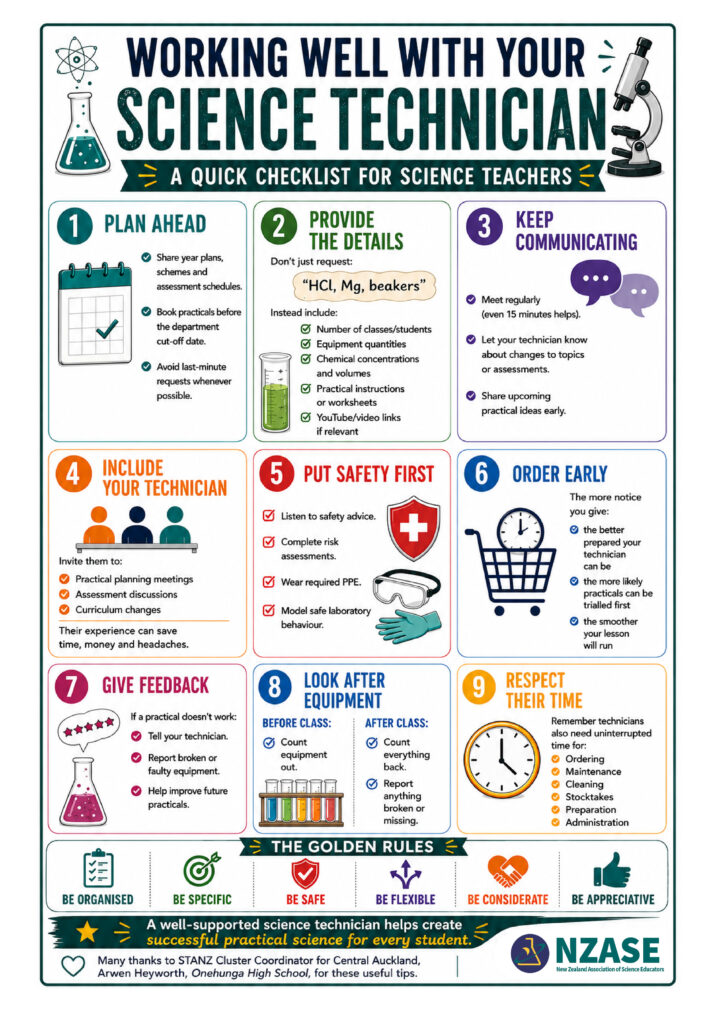
Be safe: This may be controversial to some, but your science technician is probably the most knowledgeable person in the school regarding health and safety in science and in the management of hazardous substances. After all, they are the one person in the department that works directly with hazardous substances every day, and you better believe that they have done their homework so that they can do so safely. So, when your technician advises you that a chemical/practical process is not safe the way that you want to do it, you had better listen up. Under the Health and Safety at Work Act 2015, everyone in a workplace is responsible for health and safety. Responsibility is no longer the purview of one health and safety manager; everyone is expected to do their part, and everyone shoulders the legal liability. If you ignore them and an accident happens, YOU are liable. So, when your science technician tells you that you cannot eat or drink in the lab (even if it is also your classroom), it is not an arbitrary rule that they have cooked up to thwart you; it is the law. You need to model the correct and safe behaviour for your students, so don’t eat or drink in the lab, wear covered shoes, tie your hair up, wear your safety glasses, lab coat and whatever other PPE your technician provides. They just want to keep you physically and legally safe. This includes doing your own risk assessments!
Order in advance: The more notice you give your technician, the better your results will be. With advance notice, they will be able to run a practice first to make sure that everything works so you don’t have to discover that it doesn’t in front of 30-odd students. They will also be more relaxed as they will be able to plan their day better. Technicians who are members of STANZ have the ability to consult with a nationwide online forum of experienced science technicians, so they can troubleshoot if they run into any difficulties.
Provide feedback: If something doesn’t work, or doesn’t work as well as it should, let your technician know! There may be a fault with the chemicals/equipment involved, or perhaps you are not doing the practical properly. If it doesn’t work, the technician needs to know before they make the practical available to other teachers, and if no one informs them that there is a problem, they will not know, and it won’t work for anyone.
Be accountable: If you take a trolley that your technician has prepared for you and use it with your class, you are responsible for all of the equipment on it. So, if the trolley goes out with ten stopwatches on it, it needs to come back with ten stopwatches. This means getting in the habit of counting the gear BEFORE you hand it out and then AGAIN when you collect it back in. Missing a stopwatch here or a test tube there may not seem like a big deal to you, but when it happens with every class, it adds up to a lot of missing stock that your science technician has to scramble to find replacements for. Especially when you don’t inform them that something has gone missing and then the next teacher panics thinking that it’s their class that’s lost it. Not to mention the cost to replace it. And if something is not working or broken, please don’t just dump it on the technicians’ desk with no note. They will waste their time trying to find out where it came from and what is wrong with it. Remember, most science technicians don’t work full time, so their time is also precious.
Be pleasant: If you spend some time getting to know your technician, you may discover things about them that could be useful. Things such as handy hobbies (e.g. electronics, woodworking, botany etc.), qualifications or areas of specialisation, or even just a healthy dose of common sense. Hint: Chocolate works wonders! It pays to be polite and to abide by any guidelines that your technician sets. These timeframes are normally set for a good reason.
Be flexible: Remember that technicians deal with every teacher in the department, not just you. They are wonderful, creative, clever people, but they are not miracle workers and cannot produce wonders at the drop of a hat (mostly, there is the odd exception!) The more flexible and understanding you can be, the less stress you heap on your Technician. A stress-free technician is a happy and productive one!
Be considerate: All technicians need some quiet time during the day so they can catch up on paperwork, ordering, inventory, prepping, maintenance and cleaning. This is very hard to do if you constantly have people coming in and out with last-minute requests and panic practicals. You have non-contact hours for catching up on your workload, and this helps you to be a more effective teacher; the same is true for your science technician. There will be times during the year when your technician is really under the pump (during practical exam weeks, senior chemistry practical internals like titrations, etc.); please be mindful of this and don’t put any additional and unnecessary workload on them. Your Year 9 students can wait a week to do whatever delightful investigation has taken your fancy.
I am very lucky to have the support of a wonderful, inclusive department. We are a tight-knit bunch who work effectively together as a cohesive team, but I know that there are schools out there that are not making the most of this amazing, mostly untapped resource: their science technician. Hopefully, these tips will help you address this issue.
This article was originally published in New Zealand Science Teacher in 2012 and has been updated and checked for accuracy by author Arwen Heyworth and NZASE.
Arwen Heyworth | July 2026 | Email
Feature image: Artem Podrez